## What are modes?
Firstly, why modes? Not phases or statuses, or something else? Phases are usually used for traditional waterfall projects, for example, a development phase and then a testing phase. Statuses are useful for tracking work, but an initiative moves backwards and forwards during its lifetime, sometimes multiple times during a single day. Therefore a status can be used as additional metadata to track and manage work.
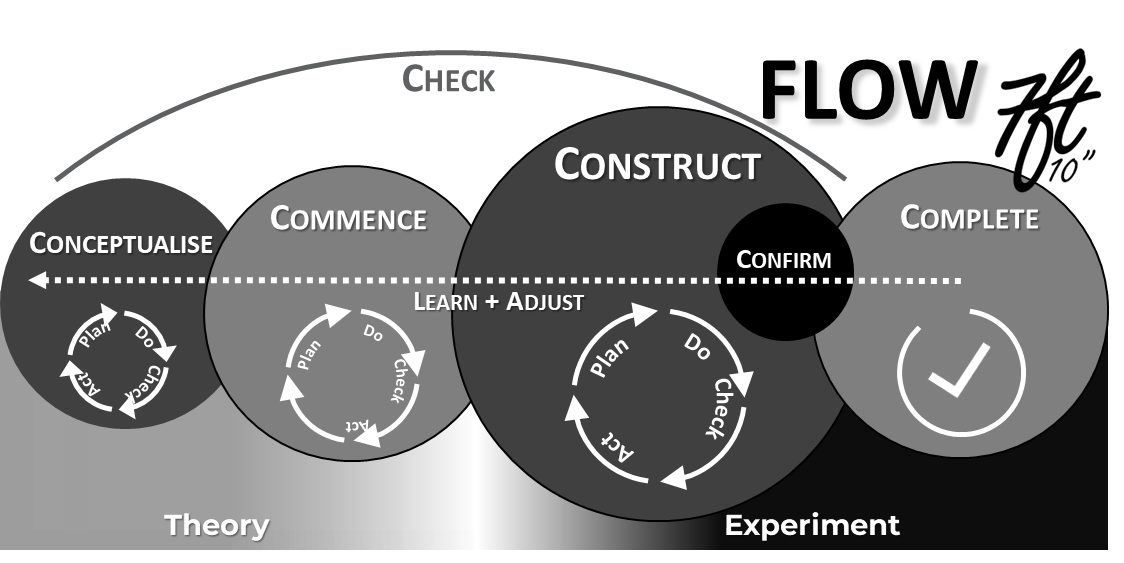
A mode, on the other hand, is something that we can slip in and out of as required. There is no linear movement through the model - even when we get to the complete mode!
### [Conceptualise Mode](https://docs.7ft10.com/flow-system/delivery-approach-flow-model/conceptualise)
Consider what this opportunity looks like, and ask the questions listed below to understand whether we want to pursue the initiative further. You may end up having a number of discussions or concept workshops as part of this phase, ensuring that the right people are involved.
### [Commence Mode](https://docs.7ft10.com/flow-system/delivery-approach-flow-model/commence)
The delivery teams will be engaged more in the detail of the change and will elaborate and break up work into right-sized chunks.
### [Construct Mode](https://docs.7ft10.com/flow-system/delivery-approach-flow-model/construct)
The delivery teams work through applying the change/s with a continuous plan-do-check-act cycle. Change management activities are undertaken during delivery to ensure the impacted parties and interested stakeholders are aware and prepared for the change when it is deployed.
### [Confirm Mode](https://docs.7ft10.com/flow-system/delivery-approach-flow-model/confirm)
Have we completed this in such a way that it will continue without us in the future? Are we done?
### [Complete Mode](https://docs.7ft10.com/flow-system/delivery-approach-flow-model/complete)
Did we actually achieve the change we wanted to change? Did we achieve the 'Why'? Are we really done? Did we create any debt that needs to be considered later on?
### [Check Mode](https://docs.7ft10.com/flow-system/delivery-approach-flow-model/check)
Agile governance should be simple and supportive. It should trust individuals and give decision-making authority to teams so they can focus on delivering.
---
# Agent Instructions: Querying This Documentation
If you need additional information that is not directly available in this page, you can query the documentation dynamically by asking a question.
Perform an HTTP GET request on the current page URL with the `ask` query parameter:
```
GET https://docs.7ft10.com/flow-system/delivery-approach-flow-model/intro-to-flow.md?ask=
```
The question should be specific, self-contained, and written in natural language.
The response will contain a direct answer to the question and relevant excerpts and sources from the documentation.
Use this mechanism when the answer is not explicitly present in the current page, you need clarification or additional context, or you want to retrieve related documentation sections.